The Lagrangian of the Electroweak Theory
Steven Weinberg
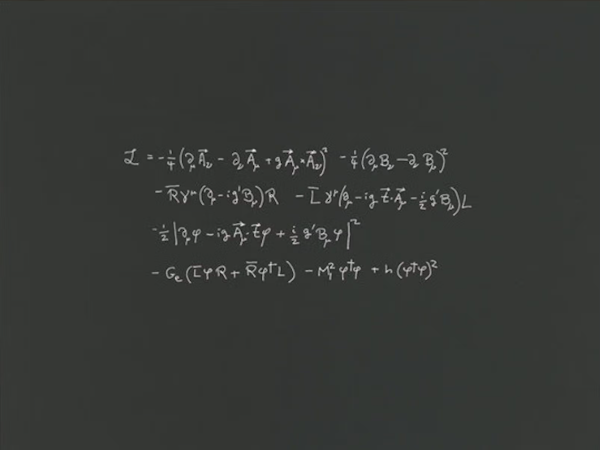
This equation presents the original version of what has become the standard theory of two fundamental forces of nature, the electromagnetic force and the weak nuclear force. The latter force, though less familiar than electromagnetism, is responsible for an important kind of radioactivity, known as beta decay, and for the first step in the chain of nuclear reactions that gives heat to the sun and stars. This equation was Eq. (4) in my first paper on this subject, published in 1967. This was for some years the most widely cited paper ever published in elementary particle physics, and may still be.
The electroweak theory is a field theory. Its fundamental ingredients are fields, including the electric and magnetic fields. The quantity denoted by £ on the left side of the equation is a combination of fields and their rates of change, known as the Lagrangian density of this theory. The Lagrangian density is something like an energy density, and it provides a convenient way of summarizing all the equations governing the fields of the theory, following rules that have been used by physicists since the 1930s.
Most of the symbols on the right-hand side of the equation denote the various fields of the theory. The weak and electromagnetic forces are transmitted by the fields A and B • the electric and magnetic fields are combinations of A and B . The neutrino and the left-handed part of the electron field (that is, the field that describes electrons that are spinning around their direction of motion like the fingers of the left-hand curling around the thumb) are united in the symbol L; the right-handed part of the electron field is denoted /?. The quantities ^and g'are numerical constants, related to the charge of the electron, whose values have to be taken from experiment.
The third and fourth lines of the equation describe the mechanism by which the symmetry of the theory between neutrinos and left-handed electrons, and between the weak and electromagnetic forces, is broken. The symbol p denotes a quartet of fields, whose interaction with the other fields gives mass to the electron, leaving the neutrino massless, and gives mass to the three particles that transmit the weak forces, leaving the photon (the particle of light) massless. The quantities Ge, M\ additional numerical constants, related to the mass of the electron and the strength of the weak forces. One of the quartet of fields included in (p corresponds to a new particle, which was not discovered experimentally until 2012.
This equation may not look beautiful. Its beauty lies in its rigidity — once its ingredients are specified, its structure is pretty well fixed by conditions of mathematical consistency. Leave out one line, or just change a minus sign to a plus sign and the whole thing would become inconsistent. and h are  
For brevity, this equation left out the muon, a heavier electron-like particle, and a corresponding type of neutrino. It was obvious that they should be included the same way as the electron and its neutrino.
In 1971 the theory was expanded to include quarks, the elementary particles that make up protons and neutrons. Since then the theory has been repeatedly confirmed by experiment.